
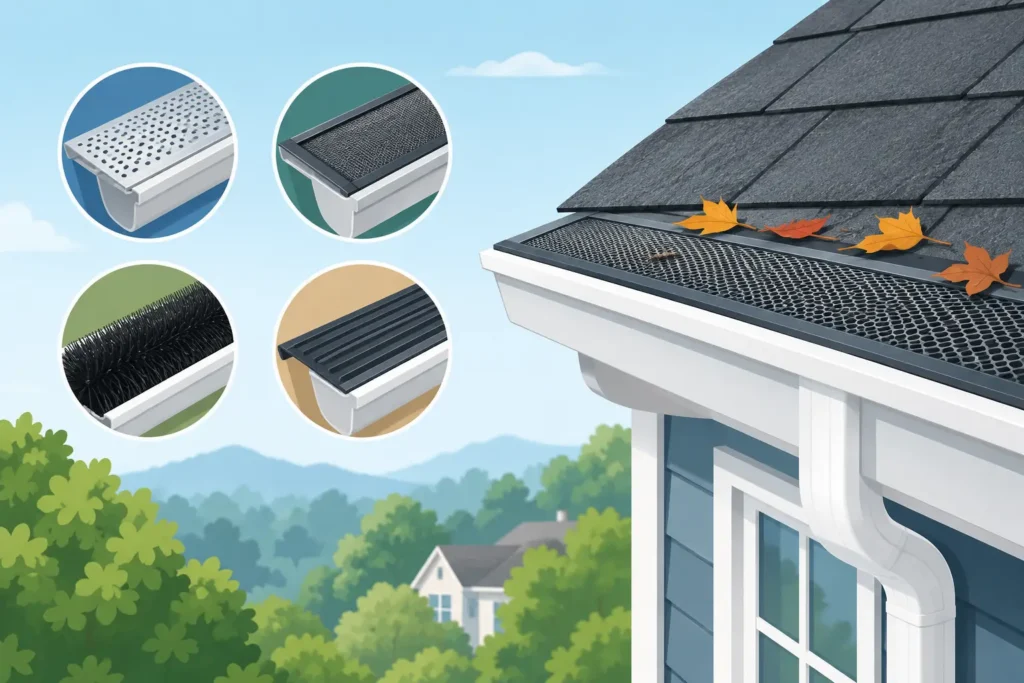
A blocked gutter rarely announces itself until water is spilling over the edge, soaking brickwork or dripping through a ceiling. For homeowners, landlords and property managers, choosing the best gutter guards for homes can reduce the amount of debris entering the system – but only when the guard suits the roof, gutter profile and surrounding trees.
Gutter guards are not a replacement for sound guttering or regular roof maintenance. They are a practical addition that can reduce cleaning frequency, particularly on properties in Northamptonshire where mature trees, moss growth and changeable weather can quickly fill open gutters. The right choice keeps leaves out while allowing rainwater to reach the downpipes. The wrong choice can trap debris on top, restrict flow or make maintenance harder.
What a gutter guard should do
A gutter guard sits over, inside or across the top of a gutter to stop larger debris entering it. Leaves, twigs, moss and nesting material are the usual culprits, although the type of debris matters more than many people realise. A home beneath broadleaf trees has different needs from a property close to conifers, where needles can pass through larger openings.
A good guard should let water enter freely, remain secure in strong wind and allow the gutter to be inspected when needed. It should also work with the existing roofline rather than being forced into place. Fascias, soffits, brackets and gutter falls all need to be in reasonable condition before guards are fitted.
There is no single product that works perfectly on every property. The best option depends on the amount and type of debris, the pitch and covering of the roof, access for future maintenance and the condition of the existing gutters.
Best gutter guards for homes: the main options
Fine mesh guards
Fine mesh guards are often the strongest all-round choice for homes affected by leaves, roof moss and smaller debris. A metal or durable plastic mesh covers the gutter opening, allowing rainwater through while filtering out much of what would otherwise collect inside.
Stainless steel mesh is generally more durable than lightweight plastic and is less likely to become brittle over time. It can be particularly useful where small leaves or seed pods are a recurring problem. However, very fine mesh can collect moss and debris on its surface. This needs to be brushed or cleared periodically, especially after autumn or prolonged windy weather.
Mesh also needs careful fitting. If it is poorly secured, it can lift at the edges, sag into the gutter or interfere with tiles. A professional installer can make sure the guard is compatible with the roof and does not compromise water flow.
Aluminium perforated guards
Perforated aluminium guards are rigid covers with evenly spaced holes. They are designed to sit neatly across the gutter and provide a cleaner appearance than some loose mesh products. Their strength makes them well suited to long, straight gutter runs and properties where a more permanent-looking finish is preferred.
The trade-off is that larger perforations may allow pine needles, grit and small fragments of moss to enter. On the other hand, holes that are too small can hold debris on the surface. They tend to perform best where fallen leaves are the main concern rather than heavy moss shedding from an older roof.
Brush guards
Brush guards are bristled inserts that sit inside the gutter. Water filters through the bristles while leaves are intended to stay on top. They are quick to install and can be a lower-cost option for straightforward gutter runs.
Their limitation is maintenance. Fine debris, moss and wet leaves can settle into the bristles, so the guard itself may need lifting out and cleaning. They are less suitable for homes that receive substantial roof moss or have large overhanging trees. A brush guard can reduce blockages, but it should not be treated as fit-and-forget protection.
Foam inserts
Foam inserts fill the gutter channel while allowing water to pass through the porous material. They are simple to fit and initially keep larger leaves out. However, they can retain moisture and collect sediment over time. In shaded areas, organic growth may become an issue.
For that reason, foam is usually a short-term or budget-led choice rather than the best long-term option. If the guttering is difficult to reach, a system that needs frequent removal is unlikely to be cost-effective.
Start with the roof and gutter condition
Fitting guards to damaged guttering will not solve the underlying problem. If brackets are loose, joints are leaking or the gutter is holding standing water, those faults should be repaired first. A gutter must have the correct fall towards the downpipe; otherwise, debris and water will still collect regardless of the guard on top.
It is also worth looking at the roof itself. Moss can break away during rain and frost, and old mortar, tile fragments or loose debris can reach the gutter. Guards can help limit the volume entering the system, but they cannot correct a roof that is shedding material due to disrepair.
Before any installation, the gutters should be cleared, flushed through and checked for leaks. Downpipes need the same attention. A partially blocked downpipe can cause overflowing gutters even when the guard is working as intended.
Consider local weather and nearby trees
Northamptonshire properties see heavy rainfall, frost, high winds and long damp periods through the year. These conditions place pressure on roof drainage, especially where gutters are undersized or poorly maintained. During a sudden downpour, water needs a clear path from roof edge to downpipe. Guards that restrict that path are not suitable.
Homes near oak, sycamore or horse chestnut trees may benefit from a quality mesh system, as larger leaves can otherwise create quick blockages. Properties near conifers need a closer look, because pine needles can be more difficult to manage. Fine mesh may be appropriate, but it will still need surface cleaning to prevent a layer of needles from stopping water from entering.
Shaded roofs also deserve attention. Moss is more likely to develop where a roof receives limited sun, and this can add a constant source of fine debris to the gutters. In these cases, roof maintenance and gutter protection should be considered together rather than as separate jobs.
Professional fitting versus DIY guards
Some guards are sold as simple DIY products, and they can be suitable for a low-level extension or garage with safe access. The risk increases on two-storey homes, steep roofs and older properties where tiles or gutter brackets may be fragile. Working from a ladder around roof edges is not a job to take lightly.
Professional fitting brings more than safe access. An experienced roofer can identify poor gutter alignment, damaged fascias, loose roof tiles and hidden leaks before a guard covers the area. They can also cut and secure materials properly around corners, outlets and downpipes – the points where many DIY installations fail.
For landlords and commercial property managers, professional installation also provides clearer accountability. The system can be assessed as part of wider roofline maintenance, rather than treating an overflowing gutter as an isolated issue each time it happens.
Gutter guards still need maintenance
The promise of “never clean your gutters again” should be treated with caution. Even the best gutter guard can gather debris on its upper surface, particularly after storms and during leaf fall. The benefit is usually less material inside the gutter and fewer serious blockages, not zero maintenance forever.
A sensible approach is to inspect gutters at least twice a year, normally in spring and late autumn. Check after severe weather as well. Look for water running over the front edge, staining on walls, sagging lengths of gutter, vegetation growing near joints and damp patches around the roofline.
If guards are installed, they should be checked for movement, gaps and debris build-up. Keeping nearby branches trimmed back can make a bigger difference than changing guard type repeatedly.
When gutter guards may not be the first answer
If water is overflowing in one place only, the problem may be a blocked downpipe, poor gutter fall or a leak at a joint. If the gutter is sagging, the brackets may need replacing. If rain is shooting past the gutter in heavy weather, the roof pitch, gutter size or tile overhang may need assessment.
In these situations, adding a guard first can hide the fault without fixing it. A proper inspection ensures money is spent on the work that will protect the property, whether that is gutter cleaning, repairs, new fascias and soffits, replacement guttering or a guard system fitted afterwards.
For homeowners across Northampton and the surrounding areas, Weathershield Roofing and Guttering Services can assess the complete roofline and recommend a practical solution based on the condition of the property. The most useful gutter guard is the one fitted to clean, correctly aligned guttering and supported by routine checks – keeping rainwater where it belongs, away from your walls, roof and foundations.