
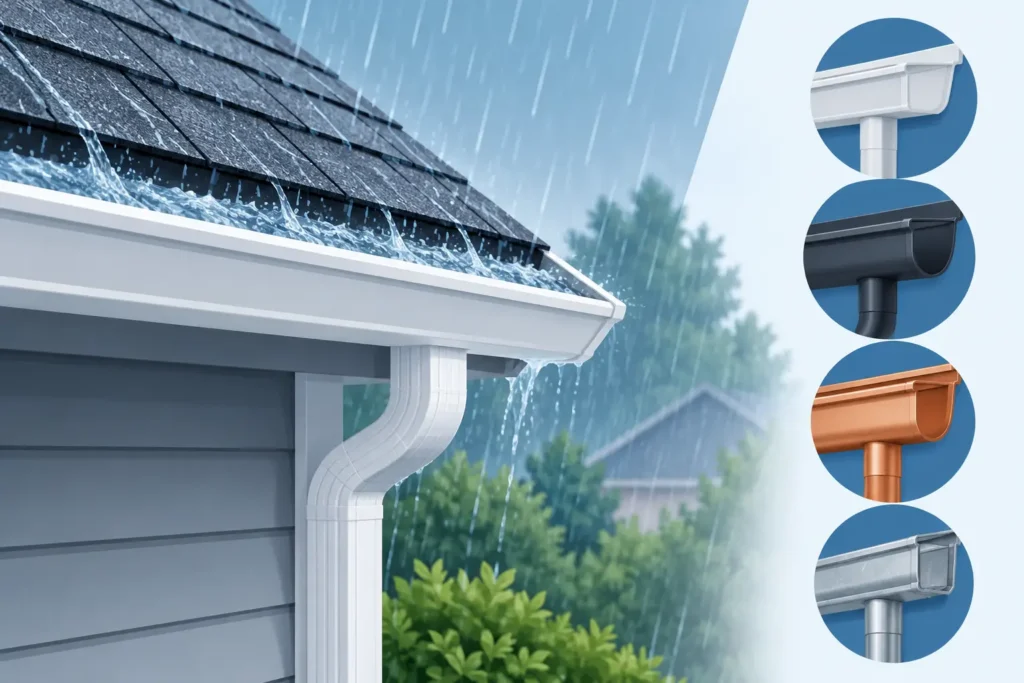
A gutter can look perfectly sound in dry weather and still fail at the first proper downpour. Water overshoots the edge, spills over joints or backs up beneath the roofline, leaving damp patches, staining and avoidable damage behind. Choosing the best gutters for heavy rain is not simply a matter of fitting a larger profile. The whole rainwater system must suit the roof, the property and the amount of water it needs to carry away.
For homes and commercial buildings across Northamptonshire, this matters particularly where roofs have broad elevations, valleys, conservatories or extensions that concentrate a large volume of water in one place. A well-designed guttering system protects fascias, soffits, brickwork and foundations as well as keeping entrances, patios and paths safer during wet weather.
What makes a gutter suitable for heavy rain?
Capacity is the starting point. A shallow, narrow gutter may be adequate on a small roof with a simple slope, but it can overflow quickly when rain falls heavily or when several roof areas discharge into one run. Larger profiles hold more water and allow it to move towards the downpipe without backing up.
However, gutter size alone does not solve every problem. Downpipes must be large enough and positioned correctly to take water away at the same rate it enters the gutter. If a gutter run is long, has only one outlet or receives water from a valley, it may need an additional downpipe. Otherwise, even a deep gutter can fill faster than it can drain.
The fall of the gutter is equally important. Gutters need a slight, consistent slope towards the outlet. Too little fall allows standing water and debris to gather. Too much can make water rush past the outlet during intense rain. Proper brackets, securely fixed at the correct spacing, keep the line stable when the system is carrying a heavy load.
Best gutter profiles for heavy rainfall
Deep-flow gutters
Deep-flow guttering is often one of the best choices for homes that regularly experience overflow during heavy rain. Its deeper shape provides more capacity than a standard half-round profile while still giving a neat, familiar appearance on most properties.
This profile is particularly useful on detached and semi-detached homes with larger roof areas, and on properties where one elevation receives a lot of run-off. It can also be a sensible option where a standard gutter has previously overflowed despite being kept clear. Deep-flow systems are available in durable uPVC and in metal options, depending on the appearance and lifespan required.
There is a trade-off. Deep-flow guttering can look more substantial than standard half-round guttering, so it may not suit every period property or very small roofline. It still needs correctly sized outlets and downpipes to deliver its full benefit.
Square-line gutters
Square-line gutters have a more angular appearance and generally offer good water-carrying capacity. They are popular on modern homes and commercial properties because the clean lines suit contemporary fascias and roof edges.
For heavy rain, a larger square-line system can be a practical choice where appearance and capacity both matter. The flat base and deeper sides help manage a useful volume of water, although the precise performance depends on the size selected, outlet arrangement and installation quality.
Square-line guttering can show dirt and standing water more readily if the fall is poor. It is therefore important that it is fitted carefully rather than simply replacing the existing profile like for like.
Half-round gutters
Half-round guttering remains a common choice for good reason. It is cost-effective, widely available and suits many traditional properties. On modest roof areas with adequate downpipes, a quality half-round system can perform well in normal British rainfall.
For particularly heavy run-off, though, standard half-round gutters are not always the strongest option. They are more likely to overflow where roof valleys feed into them, where there are long runs between outlets or where leaves and moss collect. A larger half-round profile may work, but it is worth comparing it with deep-flow guttering before making a replacement decision.
Ogee gutters
Ogee gutters have a decorative moulded profile, often chosen to complement more traditional homes. They can provide good capacity in larger sizes and offer a more detailed finish than plain half-round or square-line systems.
Their main advantage is appearance, but they should not be selected on looks alone. Some designs have internal corners where debris can settle, especially near outlets. For properties surrounded by trees, regular cleaning remains essential, whatever profile is fitted.
Choosing the right gutter material
uPVC guttering is the most common option for domestic properties. It is lightweight, affordable and available in black, white, grey and other finishes to match fascias and soffits. Modern uPVC systems can perform very well in heavy rain when they are correctly sized, supported and maintained.
For most homeowners, a quality uPVC deep-flow or larger square-line system offers a sensible balance of cost, appearance and performance. The key is not to choose the cheapest profile without considering the roof area and drainage layout.
Aluminium guttering is lighter than cast iron, resistant to corrosion and can provide a longer-lasting, more refined finish. It is often selected for higher-value homes, larger properties and buildings where long, continuous runs reduce the number of joints. Fewer joints can mean fewer potential leak points, although professional fitting is particularly important.
Cast iron suits certain heritage and period properties, especially where preserving the building’s character is a priority. It is strong and long-lasting when maintained properly, but it is heavier, more expensive and requires periodic painting to prevent corrosion. It is rarely the most economical answer to a straightforward overflow issue.
Downpipes matter as much as gutters
Many gutter problems are actually downpipe problems. A downpipe can be blocked underground, restricted by a poorly fitted shoe or simply too small for the volume of water reaching it. During a storm, this creates a bottleneck and forces water back over the gutter edge.
A roof with a valley or a large rear extension may need more than one downpipe, even if the existing arrangement appears acceptable in lighter rain. Adding an outlet at the right point can be more effective than replacing a whole gutter run with a larger profile.
The final discharge point also needs attention. Water should run into a functioning drain, soakaway or suitable rainwater system, not pool against the building. If the gully is blocked or the underground drainage cannot cope, the visible guttering may be blamed for a problem further down the system.
Signs your current gutters are undersized
Repeated overflow during heavy rain is the clearest warning, particularly when the gutters have recently been cleaned. Water spilling from one section near a valley, outlet or corner often indicates that the layout needs improving rather than merely repairing.
Look for damp or green staining on brickwork beneath the gutter line, peeling paint on timber fascias, washed-out areas near downpipes and water marks under eaves. Sagging gutters are another concern. They may have inadequate bracket support, damaged fixings or a weight of standing water caused by poor falls and blockages.
Do not ignore water that runs behind the gutter. This can soak the fascia board and eventually affect the roof edge. A new gutter fitted to rotten timber will not provide a lasting solution, so the roofline should be inspected as part of the work.
Maintenance still protects the best system
Even the highest-capacity gutter can overflow if leaves, moss and silt block the flow. Gutters should be checked at least twice a year, usually in spring and after autumn leaf fall, and after severe storms. Properties near mature trees may need more frequent attention.
Clear outlets and downpipes as well as the gutter channel itself. Check brackets, joints and end caps for movement or leaks, and make sure water is entering the drainage point freely. Gutter guards can reduce larger leaf build-up in some situations, but they are not maintenance-free and can collect moss or fine debris on top.
For a property with recurring overflow, a professional assessment is worthwhile. An experienced roofer can identify whether the cause is capacity, fall, a blocked drain, damaged fascias or water being concentrated by the roof design.
A practical choice for Northamptonshire properties
There is no single gutter profile that is right for every building. In many cases, deep-flow uPVC guttering with correctly placed, adequately sized downpipes is a dependable solution for heavy rain on a typical family home. Larger square-line systems may suit more modern properties, while aluminium or cast iron can be appropriate where appearance, longevity or heritage requirements lead the decision.
At Weathershield Roofing and Guttering Services Ltd, we assess the full roofline rather than treating an overflowing gutter as an isolated fault. The right answer may be a repair, a new outlet, replacement fascias and guttering, or a complete rainwater system designed for the roof above it. Addressing the cause before the next spell of heavy rain is the simplest way to keep water where it belongs: safely away from your property.