
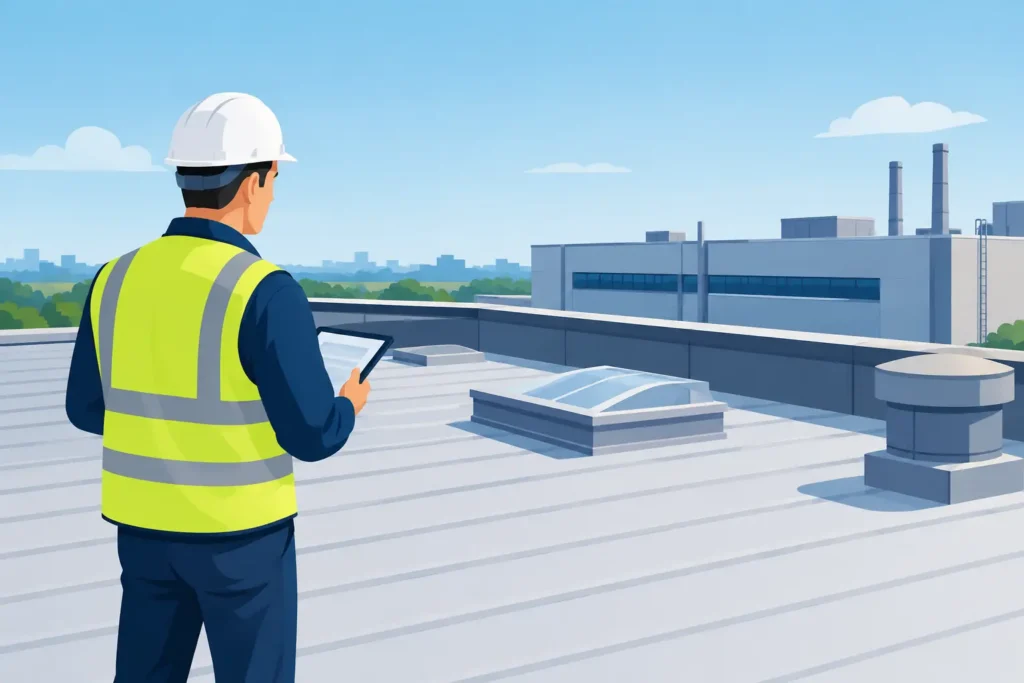
A small split in a flat roof covering or a blocked outlet can become a costly operational problem long before rainwater appears inside the building. This guide to industrial roof inspections helps property managers, landlords and business owners recognise what should be checked, how often it should happen and when professional attention is needed.
Industrial roofs are often large, difficult to see from ground level and fitted with equipment that complicates access. Regular inspections are therefore less about finding fault for its own sake and more about protecting the building, stock, machinery and people beneath it. A planned approach gives you time to arrange repairs before a minor defect leads to internal damage or disruption.
Why industrial roof inspections deserve a plan
A commercial or industrial roof has to cope with more than ordinary rainfall. It may carry air-conditioning units, extraction systems, solar panels, rooflights, pipework and frequent maintenance traffic. Large roof areas also direct a significant volume of water towards gutters, valleys and outlets. If drainage is restricted, standing water can add pressure to the roof covering and expose weak points around joints.
The cost of waiting is rarely limited to the roof itself. Water ingress can damage insulation, ceilings, electrics, stored goods and equipment. It can also create slip risks, interrupt trading or affect tenants. Early inspection makes repair work more manageable, more predictable and usually less intrusive.
The right inspection schedule depends on the roof type, its age, how exposed the site is and the amount of rooftop equipment. As a sensible starting point, arrange a professional inspection at least once a year, plus checks after severe weather. Older roofs, roofs with recurring drainage issues and heavily used premises may need inspections every six months.
Start with safety, access and records
Do not treat roof access as a quick visual check. Industrial roofs can have fragile rooflights, hidden weak areas, unprotected edges and slippery surfaces. Staff should not walk on a roof unless they are trained, authorised and equipped to do so under a suitable safe system of work.
Before any inspection, review access arrangements, edge protection, walkways, roof hatches and any restrictions around plant equipment. A qualified roofer can assess the roof safely while avoiding accidental damage to the covering. This is particularly relevant on older asbestos cement sheets, where specialist advice and controls may be required.
Keep a simple roof file for each building. It should include previous inspection reports, photographs, repair invoices, warranty details and notes on leaks or areas where water tends to collect. Clear records help identify repeat faults and show whether a defect is changing over time. They are also useful when planning maintenance budgets or discussing responsibilities with tenants and insurers.
What to check during an industrial roof inspection
A proper inspection considers the whole roof system rather than only the area directly above a reported leak. Water can travel along deck joints, insulation or structural members, so the point where it appears internally may not be the point where it entered.
Roof covering and seams
The checks differ slightly between flat roofs, metal sheet roofs and pitched industrial buildings, but the principle is the same: look for breaks in the weatherproof layer. On felt, single-ply or liquid-applied flat roofs, this may include cracks, splits, blisters, lifted laps, open seams and worn surfaces. Pay close attention to repairs completed in previous years, as these can show where movement or water ponding has occurred.
On metal roofs, inspect for corrosion, loose or missing fixings, damaged sheets, failed sealants and gaps at overlaps. Rust around fixings can indicate that water is getting beneath the surface. With pitched roofs, slipped tiles, broken slates, damaged ridge lines and deteriorated mortar should be investigated before they allow water into the roof space.
Flashings, edges and penetrations
Many leaks begin where materials meet. Flashings around rooflights, vents, ducts, parapet walls and plant bases need careful examination. Look for cracked sealant, loose edges, gaps, punctures and signs that the roof covering has pulled away from an upstand.
Roof edges matter just as much. Check that perimeter trims are secure and that coping stones, parapet caps and wall flashings are intact. Wind can loosen these areas gradually, particularly on exposed industrial estates, and the damage is not always obvious from ground level.
Drainage and standing water
Gutters, outlets, gullies and downpipes should be clear enough to move water away quickly. Leaves, moss, silt, nesting material and loose debris can all cause blockages. On large roofs, even a partial blockage can lead to ponding after heavy rain.
Look for standing water, staining around outlets, vegetation growth and sagging gutters. These signs may point to a drainage issue, but they can also indicate a low spot caused by movement in the roof deck or insulation. Clearing an outlet may solve the immediate problem; repeated ponding may require a more detailed assessment and corrective work.
Rooflights and rooftop equipment
Rooflights are useful for natural light but can become brittle with age. Inspect their seals, surrounding flashings and fixings, while keeping in mind that they may be fragile underfoot. Condensation or discolouration on the inside can be an early warning of a failing seal.
Plant equipment creates multiple potential entry points for water. Check the bases of air-conditioning units, extractors, pipe penetrations and cable routes. Make sure any supports have not damaged the roof surface and that maintenance engineers have not left loose fixings, offcuts or access panels behind.
Inspect the building from inside as well
An external inspection should be supported by an internal check, especially after prolonged rain. Look along ceilings, roof voids and upper walls for staining, mould, drips, damp insulation, peeling paint or corrosion. A musty smell can also suggest hidden moisture.
Ask occupiers and maintenance staff whether they have noticed leaks, draughts or unusual temperature changes. Their observations can help narrow down intermittent faults that are not visible on a dry day. Record the location, weather conditions and time of each report rather than relying on memory.
When a defect needs prompt action
Some problems can be scheduled into planned maintenance, while others should be dealt with quickly. Active water ingress, loose sheets or flashings, blocked drainage during wet weather, visible sagging, storm damage and deteriorating rooflights all need an early professional assessment. Temporary patching can sometimes limit immediate damage, but it should not replace a proper repair plan.
It also pays to act before a leak appears. Cracked seals, minor corrosion, local blistering and loose fixings are often straightforward to repair when found early. Leaving them through another winter can allow water beneath the surface, where the repair becomes more involved.
Use inspection findings to plan maintenance
The most useful inspection report does more than list defects. It separates urgent safety or weatherproofing issues from routine maintenance, identifies likely causes and includes clear photographs. It should also explain whether a local repair is appropriate or whether the roof covering is nearing the stage where wider renewal needs to be considered.
Replacement is not always the answer. A relatively young roof with isolated damage may be well suited to targeted repairs and improved drainage maintenance. Conversely, repeated patch repairs across an ageing roof can become poor value and leave the building exposed to ongoing disruption. The condition of the deck, insulation, flashings and drainage should guide the decision, not the visible surface alone.
For businesses across Northamptonshire, arranging inspections with a local, qualified contractor also makes it easier to respond quickly when a fault is found. Weathershield Roofing and Guttering Services Ltd can assess industrial roof concerns, explain the practical options and provide a clear quotation for the work required.
A roof inspection works best when it becomes part of normal property care, not an emergency response to a stain on the ceiling. Keep accurate records, act on small faults and arrange safe professional checks after harsh weather. That steady approach protects the building and gives you more control over when maintenance takes place.