
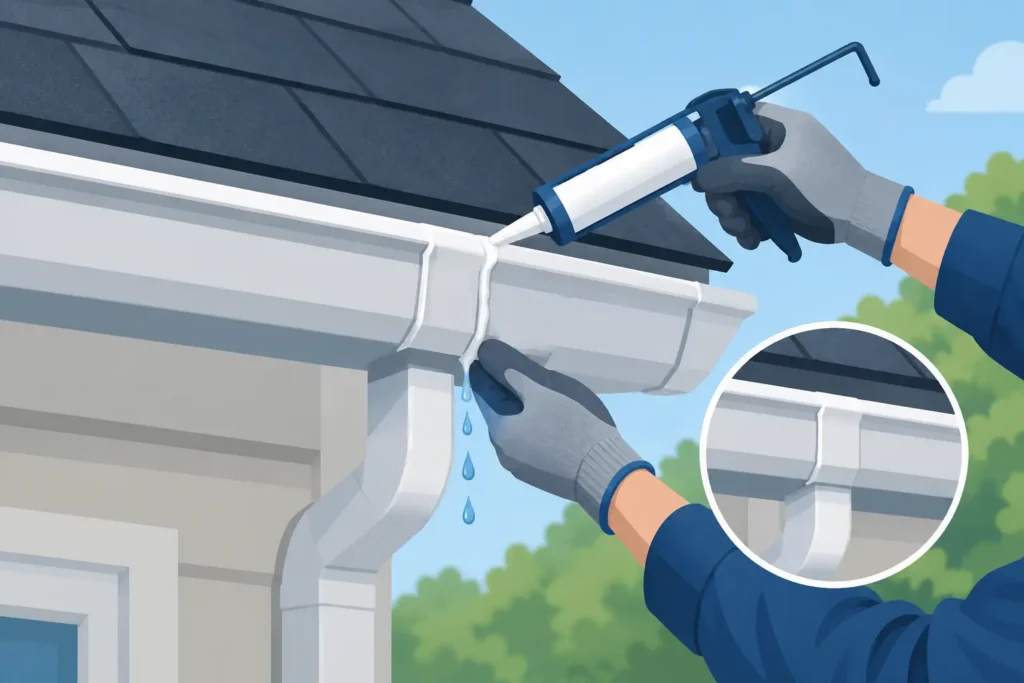
A drip from a gutter joint may look minor from the ground, but repeated overflow can soak brickwork, stain render and leave water collecting around your property’s foundations. Knowing how to fix leaking gutter joints can help you deal with a small maintenance issue before it develops into damaged fascias, damp walls or a more costly gutter replacement.
The right repair depends on the gutter material, the age of the installation and why the joint has started to fail. Sometimes it is simply a displaced rubber seal. In other cases, a blocked downpipe or a section of gutter that has dropped out of line is forcing rainwater through an otherwise sound joint.
Find the cause before applying sealant
It is tempting to run a bead of sealant around the outside of a leaking joint and call the job done. That can provide a short-term improvement, but it will not solve a problem caused by poor alignment, failed seals or standing water in the gutter.
Wait until conditions are dry, then inspect the joint closely from a safe position. Look for staining beneath the connector, gaps between the gutter and fitting, cracked plastic, rust, loose clips and debris sitting inside the channel. If water only appears during heavy rain, the system may be overflowing because leaves, moss or silt are restricting the flow towards the downpipe.
A gutter should fall gently towards the outlet. If water sits in the section next to the joint after rain has stopped, the gutter may be sagging or incorrectly pitched. In that situation, resealing the connection alone is unlikely to last.
Work safely at height
Gutter repairs often require a ladder, and this is where a straightforward job can become unsafe. Use a sound ladder on level ground, secure it where possible and avoid stretching sideways to reach the work. Have another person nearby if you are working above ground level.
Do not attempt a repair in rain, strong wind or icy conditions. If the joint is above a conservatory, extension roof, awkward driveway or uneven ground, a professional roofer is usually the safer choice. Property managers should also consider whether access equipment is needed before arranging work at height.
How to fix leaking gutter joints on uPVC systems
Most modern homes have uPVC guttering, which is durable and usually designed with clip-together union brackets. These fittings contain rubber seals that create a watertight connection. Over time, the seals can dry out, twist, collect dirt or lose their grip.
Clean the gutter and joint
Start by removing leaves, moss and debris from the gutter run. Flush it through with clean water once it is clear. This lets you see whether the leak comes from the joint itself or whether water is spilling over the edge elsewhere.
Release the gutter section from the union bracket carefully. Depending on the fitting, you may need to unclip retaining tabs before easing the gutter out. Avoid forcing old plastic, particularly in cold weather, as it can crack.
Clean the inside of the fitting and the end of the gutter with a cloth. Remove dirt from the rubber seal and check whether it is split, flattened or missing. The gutter end should be clean and smooth where it meets the seal.
Refit or replace the rubber seal
If the seal is in good condition, refit it properly and apply a small amount of silicone-based lubricant made for rubber seals. This helps the gutter slide into position without rolling or pinching the rubber.
Push the gutter back into the bracket until it reaches the insertion mark inside the fitting. Most unions allow for slight movement as the gutter expands and contracts with changing temperatures, so do not force it beyond the marked line.
If the rubber has perished, become distorted or will not stay in place, replace it. Replacement seals are inexpensive, but they must match the profile and size of the existing gutter system. A poorly matched seal can leak just as quickly as the old one.
When sealant is useful
Sealant can help where a compatible joint has a very small persistent gap, but it should not be treated as the main repair for a failed uPVC union. Standard silicone does not always adhere reliably to weathered plastic, and it can make future replacement more difficult.
If sealant is used, choose a high-quality exterior gutter sealant, apply it only to a clean and dry surface, and follow the curing time on the product. Never seal over trapped water, loose dirt or a visibly cracked connector. Replace the fitting instead.
Repairing metal gutter joints
Cast iron, aluminium and galvanised steel gutters are more common on older homes, period properties and some commercial buildings. Their joints may be sealed with specialist mastic, bolts, clips or gaskets rather than rubber push-fit seals.
Surface rust around a metal joint needs attention before resealing. Remove loose flaking material, clean the area thoroughly and assess whether the metal is still sound. A pinhole, deep corrosion or a crack in cast iron usually means the affected section needs replacing rather than covering with mastic.
For a sound joint, remove the failed sealant as far as practical, dry the surfaces and apply an appropriate roofing or gutter mastic. Where fixings are loose or corroded, they should be renewed using suitable components. Take care not to overtighten bolts on older cast iron sections, as the material can fracture.
Metal gutter repairs can be more involved because the sections are heavy and often need repainting or treating after work is complete. For heritage-style guttering, it is worth using a contractor familiar with the material rather than risking damage to a costly system.
Check the fall, brackets and downpipe
A repaired joint will only stay dry if water can move freely through the gutter. Check that brackets are firmly fixed and evenly spaced. A loose bracket near a union can pull the gutter out of the seal or create a low point where water pools.
You should also inspect the outlet and downpipe. Water backing up from a blocked downpipe can put pressure on every joint in the run. Clear accessible blockages and make sure the downpipe is securely connected at each section.
If several joints are leaking, or the gutter is bowed along its length, isolated repairs may be poor value. A partial replacement or full new guttering installation can provide a neater, longer-lasting answer, particularly where fascias and soffits are also showing signs of age.
Test the repair properly
Once the joint has been refitted or resealed, test it with a hose or by pouring water into the gutter away from the joint. Use a steady flow rather than blasting water directly into the connection. Watch for drips underneath and check that water travels towards the downpipe without pooling.
Test again after the next period of heavy rain. Small leaks can be hard to spot during a quick inspection, especially if the gutter only overflows when there is a high volume of water on the roof.
When to call a guttering professional
A single loose uPVC joint can often be repaired by a confident homeowner. It is sensible to call a professional where access is unsafe, the gutter is cracked, joints keep failing or there are signs that water has already affected the roofline.
Look out for rotting timber fascias, peeling paint, internal damp patches near the eaves, movement in gutter brackets or water running down exterior walls. These signs may point to a wider roof drainage issue rather than one defective connector.
For homeowners, landlords and commercial property managers across Northamptonshire, Weathershield Roofing and Guttering Services Ltd can inspect leaking gutters, identify the cause and carry out repairs or replacement work with clear, practical advice. A professional inspection is particularly worthwhile when the guttering is difficult to reach or forms part of a larger roof repair.
A dry gutter joint is not just about stopping an annoying drip. It helps direct rainwater away from the parts of your property that are expensive to put right, so acting early is usually the most sensible repair decision.