
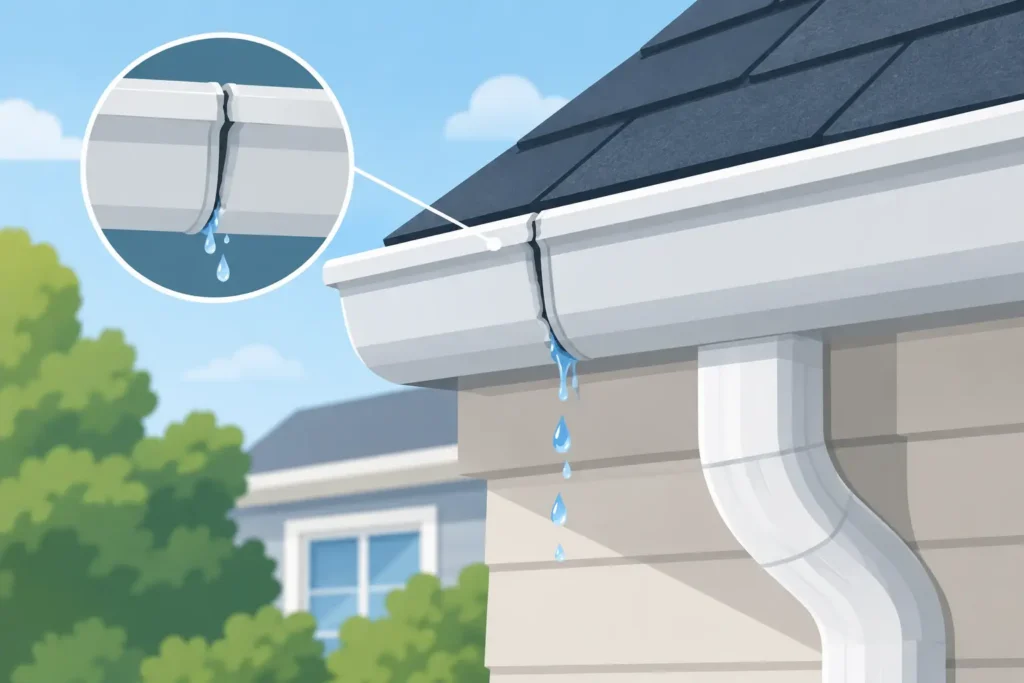
A drip from a gutter joint can look like a small problem, especially when it only appears in heavy rain. Left alone, though, that steady flow can stain brickwork, soak fascias, damage paths and patios, and allow water to collect around the base of your property. Understanding what causes leaking gutter joints helps you deal with the right issue rather than repeatedly applying sealant to a fault that will return.
What causes leaking gutter joints?
Gutter joints leak when two gutter sections, or a gutter section and an outlet, no longer form a watertight connection. In most modern plastic guttering systems, the joint relies on a shaped rubber seal inside a union bracket. The gutter must sit fully into that seal and remain properly supported as it expands, contracts and carries rainwater.
A leak does not always mean the joint itself is defective. The cause may be movement in the gutter run, a blockage putting pressure on the system, worn seals or incorrect alignment. Finding the reason matters because the right repair can be straightforward, while the wrong one may only disguise the problem for a short time.
Worn, dry or displaced rubber seals
Rubber seals are often the first part of a gutter joint to fail. Years of sun, frost, rain and temperature changes can make them dry, flattened or brittle. Once the seal loses its flexibility, it cannot press evenly against the gutter edge, allowing water to escape at the corners or along the bottom of the union.
Seals can also become twisted, dirty or dislodged when guttering is removed for cleaning or repair. Grit, moss and old sealant trapped inside the joint prevent the gutter from seating correctly. Adding more sealant on top may slow the drip temporarily, but it does not restore a damaged or misplaced seal.
Gutter sections moving with temperature changes
Plastic guttering naturally expands in warm weather and contracts in colder conditions. A properly fitted system allows for this movement through marked insertion points inside the joints. If a gutter has been pushed too far into a union, fitted too tightly or fixed without enough support, it can pull away from the seal as the temperature changes.
This is why some leaks seem seasonal. A joint that is dry through summer may begin dripping during a cold, wet spell, then appear to improve again later. It can also explain why a joint leaks only during prolonged rainfall, when the gutter is full and any slight gap becomes more obvious.
Sagging gutters and loose brackets
Gutters need a gentle, consistent fall towards the downpipe. When brackets become loose, broken or spaced too far apart, the gutter can sag between them. Water then sits in low points instead of travelling freely to the outlet.
The added weight puts strain on nearby joints and can pull a gutter section out of alignment. You may notice standing water after rain, a visible dip along the roofline, or water spilling from a joint rather than flowing towards the downpipe. In these cases, replacing a seal alone will not resolve the underlying issue. The gutter line needs to be re-supported and set to the correct fall.
Blockages creating overflow and pressure
Leaves, moss from the roof, nesting material and general debris can block gutters and downpipes. Water backs up behind the blockage until it rises above the normal flow line. It may then pour over the front edge, run behind the gutter or force its way through a weak joint.
A joint leak after heavy rain can therefore be a maintenance issue rather than a failed fitting. Clearing the system is essential, but it is also worth checking why so much debris is reaching the gutter. Overhanging trees, deteriorating roof mortar or excessive moss growth can make blockages return quickly.
Poor installation or mismatched components
Guttering components from different manufacturers can look similar but may not fit together accurately. Even small differences in profile, depth or seal position can leave a joint vulnerable to leaking. Older systems may also have parts that are no longer readily available, leading to unsuitable repairs carried out in the past.
Installation quality makes a real difference too. A joint needs clean surfaces, correctly positioned seals and gutters cut squarely so they sit evenly in the union. Brackets must be firmly fixed to sound fascias at suitable intervals. If the fascia board is rotten or distorted, the guttering fixed to it will not remain stable for long.
Storm damage, impact and ageing materials
Strong winds, heavy snow, falling branches and a ladder placed against the gutter can all shift or crack a joint. The damage is not always immediately visible from ground level. A hairline crack in a union bracket or outlet can open when the gutter fills with water, creating an intermittent leak.
Ageing also affects the gutter itself. Older plastic can become brittle, while metal systems may corrode at joints and fixings. Where several joints are leaking, sections are distorted or the system is near the end of its serviceable life, a targeted repair may become poor value compared with replacing part or all of the gutter run.
How to tell where the leak is coming from
The point where you see water dripping is not always the point where the fault begins. Water can track along the underside of a gutter or run behind the fascia before dropping several inches away. If it is safe to do so, inspect the gutter during light rain from ground level and look for the first sign of water escaping.
Check whether water is overflowing from the top, dripping from the centre of a union, escaping from an outlet, or running down the face of the fascia. Overflow usually suggests a blockage, incorrect fall or undersized capacity. A clean drip directly beneath a joint more often points to a seal, alignment or cracked fitting issue.
Avoid leaning ladders directly on guttering or attempting high-level repairs in wet conditions. Guttering can be fragile, and a minor leak is not worth the risk of a fall or causing further damage to the roofline.
Can leaking gutter joints be repaired?
In many cases, yes. A sound gutter system with one leaking union may only need the joint taken apart, cleaned and fitted with a new seal or replacement bracket. If movement is the cause, the repair should include checking bracket spacing, expansion gaps and the fall towards the downpipe.
However, repair is not always the best answer. Repeated leaks across several joints, brittle gutter sections, cracked outlets and failing fascias can indicate a wider roofline problem. Replacing isolated parts on an ageing system can become more expensive than installing new guttering that is properly aligned and securely fixed.
The right choice depends on the condition of the entire run, not just the visible drip. For landlords and commercial property managers, this broader view is particularly useful, as water damage and reactive call-outs can cost more than planned maintenance.
When to arrange a professional inspection
It is sensible to arrange an inspection when a joint continues to leak after cleaning, when water is running behind the gutter, or when you can see sagging and loose brackets. Prompt attention is also worthwhile if damp marks are appearing internally near the roofline, as the source may involve fascias, soffits or roof coverings as well as the gutter.
A qualified roofer can assess the guttering alongside the surrounding roofline, identify whether a local repair is suitable and provide a clear recommendation. At Weathershield Roofing and Guttering Services Ltd, this means looking beyond the immediate leak so that repairs are completed with the long-term condition of the property in mind.
A dry gutter joint should guide water away quietly and reliably. If yours is dripping, overflowing or pulling away from the roofline, dealing with it before the next spell of heavy rain can help protect the parts of your property that water reaches first.