
A gutter overflowing above the front door may look like a small maintenance issue. Left through a Northamptonshire winter, however, it can soak brickwork, stain render, undermine paths and send water into places it was never meant to reach. This guide to rainwater drainage systems explains how the parts work together, what tends to go wrong and when a professional inspection is the sensible next step.
A good drainage system does not simply move water off the roof. It controls where that water goes, protecting the roofline, external walls, foundations and surrounding ground. Whether you own a house, manage rental properties or are responsible for commercial premises, regular attention can prevent avoidable repair costs.
What a rainwater drainage system does
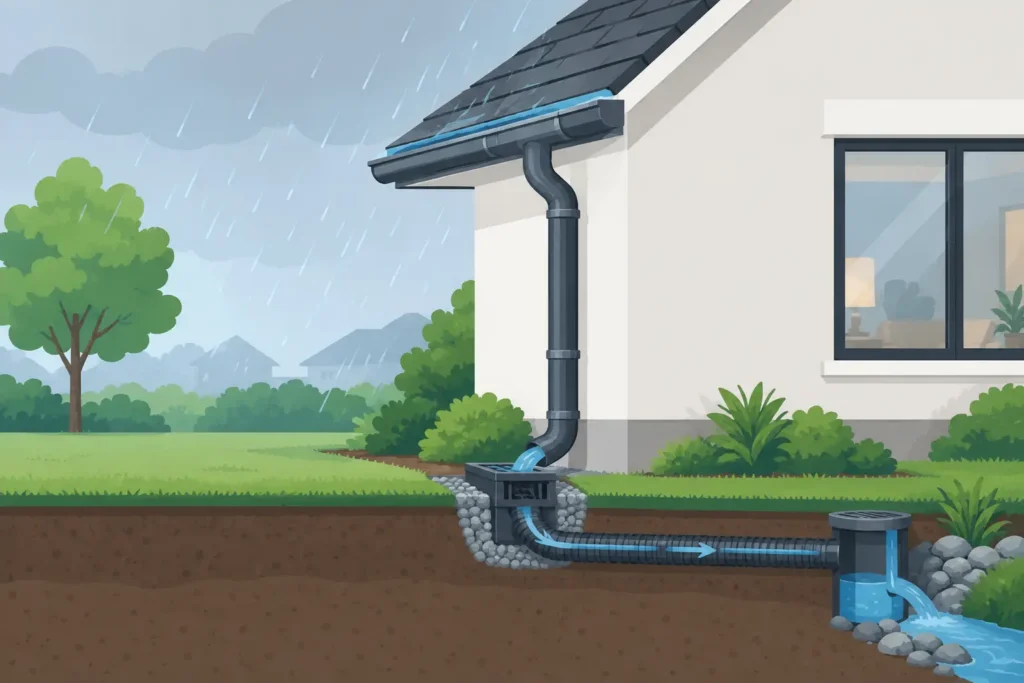
Rainwater falls onto the roof covering and runs towards the eaves. Gutters collect it, downpipes carry it down the building, and gullies, drains or suitable ground drainage direct it away safely. Every part needs to be correctly sized, securely fixed and kept clear.
In a typical property, the system includes gutters along the roof edge, outlets that connect to downpipes, brackets that hold the guttering at the right angle, and hoppers or gullies at ground level. Some homes also use water butts, soakaways or surface-water drains. The exact arrangement depends on the property, the roof area, local ground conditions and where water can legally and practically discharge.
The principle is straightforward: rainwater should flow freely from the roof to a safe outlet without spilling onto the building. Problems usually appear when there is a blockage, a poor fall in the gutter run, loose joints, damaged sections or insufficient capacity for heavy rainfall.
A guide to rainwater drainage systems: the key parts
Gutters
Gutters catch rainwater as it runs off the roof. They must be installed with a slight, controlled fall towards the outlet. Too little fall allows standing water and debris to collect; too much can cause water to rush past the outlet in heavy rain.
Plastic guttering is widely used because it is cost-effective, neat and resistant to corrosion. Aluminium, steel and cast iron may suit particular building styles or commercial applications, but they require the right specification and maintenance. Material matters, but correct fitting matters just as much. A quality gutter can still leak if its brackets are poorly spaced or its joints are not properly sealed.
Downpipes and outlets
The outlet is where water leaves the gutter and enters the downpipe. This is a common blockage point, especially where moss, leaves and roof debris build up. Downpipes should be firmly clipped to the wall and kept clear from top to bottom.
If water spills from a gutter outlet during rain, the downpipe may be blocked or overwhelmed. It is also worth checking that the bottom of the pipe is connected correctly to the gully or drainage point. A disconnected shoe can saturate the ground beside the property, which is particularly unhelpful near foundations, patios and door thresholds.
Gullies, drains and soakaways
At ground level, a gully receives water from the downpipe and channels it into drainage pipework. Gullies need clearing just as gutters do. Silt, leaves and loose debris can collect beneath the grate, slowing drainage and causing water to back up.
Not every property drains in the same way. Some rainwater systems connect to surface-water drainage, while others use soakaways that disperse water gradually into the ground. A soakaway can be effective where ground conditions are suitable, but it is not a simple answer for every site. Clay-heavy ground, high water tables, restricted space and nearby foundations all need consideration.
Why rainwater drainage problems develop
Most failures start gradually. Autumn leaves and moss are frequent causes, especially on properties near mature trees. Once a small blockage forms, standing water can add weight to the guttering, pull brackets loose and expose weak joints.
Age also plays a part. Older gutters can become brittle, seals can shrink and metal components may corrode. Movement in the building or roofline can alter the gutter fall, while ladders, storms and accidental knocks can crack a section or dislodge a downpipe clip.
Heavy rainfall exposes systems that were already struggling. A gutter that copes during a light shower may overflow during a prolonged downpour because the outlet is restricted or the gutter capacity is too small for the roof area. This is why the best time to assess performance is often during, or shortly after, rain – provided it is safe to do so from ground level.
Warning signs worth acting on
Water marks on external walls, peeling paint around windows, damp patches inside upper rooms and green staining below gutters can all point to poor rainwater control. Other signs include a visible gutter sag, drips from joints long after rain has stopped, overflowing gullies and pools of water beside the building.
Do not assume every damp issue is caused by guttering. Defective roof coverings, damaged flashing, condensation and plumbing leaks can produce similar symptoms. A proper inspection looks at the whole route water takes, from the roof surface to the ground drainage, rather than replacing one part on guesswork.
For landlords and commercial property managers, reporting small signs early is particularly worthwhile. An overflowing downpipe above an entrance, for example, can create a slippery surface as well as damaging the building fabric.
Simple maintenance that makes a difference
Most properties benefit from gutter clearing at least once a year, usually after leaf fall. Homes surrounded by trees, or roofs that collect moss, may need more frequent attention. This should include clearing gutters, checking outlets and downpipes, and removing debris from gully grates.
From the ground, look for obvious sagging, misaligned joints, loose downpipes and staining on walls. After rainfall, check whether water is running where it should. Avoid leaning ladders against plastic guttering and do not attempt high-level work without the right equipment, experience and conditions.
Gutter guards can reduce the volume of leaves entering a system, but they are not maintenance-free. Fine debris and moss can still gather on top or around them, and some designs restrict flow if they are not selected and fitted carefully. They can be useful in the right setting, but regular checks remain necessary.
When repair is enough and when replacement is wiser
A single leaking joint, loose bracket or blocked downpipe can often be repaired without replacing the whole system. Targeted work is usually the sensible option when the rest of the guttering is sound, correctly aligned and suited to the property.
Replacement becomes more cost-effective when several lengths are cracked, brackets are failing repeatedly, joints leak in multiple places or the existing system is undersized. It can also make sense as part of wider roofing work, particularly when renewing fascias, soffits or a roof covering. Completing connected work together can give a cleaner finish and reduce the need for repeated access equipment.
For older properties, appearance may influence the choice of material and profile. For newer homes, matching existing roofline features may be the priority. The right solution should balance appearance, durability, drainage capacity and budget rather than relying on a one-size-fits-all option.
Choosing professional help
Rainwater drainage work is often treated as a quick fix, yet poor installation can create ongoing trouble. A qualified roofer or guttering specialist should assess the roofline, check the gutter fall, examine joints and brackets, and consider the condition of the downpipes and ground-level drainage.
Ask for a clear explanation of the issue, the proposed repair and whether there are related defects that need attention. For larger replacements, it is reasonable to ask what materials will be used, how the system will be supported and what guarantee applies to the workmanship.
Weathershield Roofing and Guttering Services Ltd provides practical guttering and roofline support for homeowners and property managers across Northamptonshire. With more than 15 years of hands-on experience, the focus is on identifying the cause of the problem and completing work to a standard that lasts.
Rain rarely gives much notice. Keeping gutters clear and drainage routes working properly is one of the simplest ways to protect your property before the next heavy spell puts the system to the test.